From Poison to Pipeline: What China's Gutter Oil Story Can Teach the Philippines
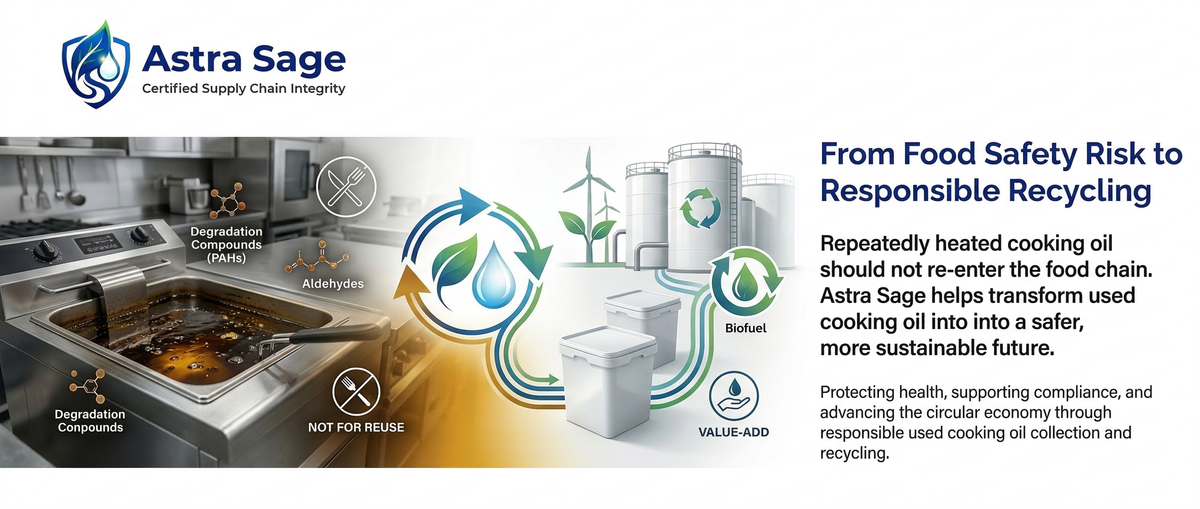
How a food-safety nightmare became a USD 2.64 billion industry — and why Manila, Cebu, and Davao have a narrow, closing window to do the same.
The oil that was killing people
Fifteen years ago, one in ten meals in China was reportedly cooked in poison.
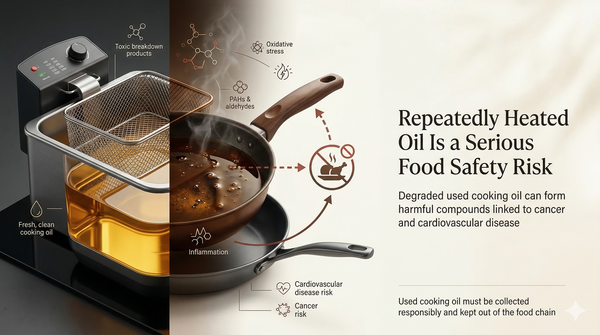
"Gutter oil" — digouyou — was the blunt name for what was happening. Waste cooking oil, along with greasy runoff scraped from drains, restaurant trap waste, and slaughterhouse offal, was being collected by informal middlemen, crudely refined, rebottled, and sold back to restaurants at a discount. By 2010, independent estimates placed it at roughly 10% of China's edible-oil market, with about 3 million tonnes per year recycled back to dining tables. A 2017 study in Global Health Promotion found that 85% of Chinese consumers were worried about it — and estimated that 2–3 million tonnes of oil containing carcinogenic compounds were being served in restaurants every year.
This wasn't a fringe problem. It was a mass-market public-health emergency hiding in plain sight.
How China actually responded — and what the popular story gets wrong
The tidy version of this story — the one that circulates on LinkedIn — goes like this: China got tough, executed a few offenders, and solved the problem. That version is wrong in ways that matter for anyone trying to learn from it.
Here's what actually happened.
In August 2011, the Supreme People's Court, the Supreme People's Procuratorate, and the Ministry of Public Security jointly authorised the death penalty for the most serious gutter-oil offences. The first nationwide campaign uncovered 100 manufacturers and arrested over 800 people. A second wave in April 2012 produced 100+ more arrests and shut down 13 illegal workshops across four provinces. By October 2013, a Jiangsu producer was handed a life sentence; by January 2014, Zhu Chuanfeng received the death penalty with a two-year reprieve.
The enforcement was real. But here's the part the triumphalist version skips: the technology never worked. In 2011, seven central ministries commissioned a joint project to develop a reliable gutter-oil test. Five proposed methods — based on PAH content, cholesterol, conductivity, gene markers, and more — were formally rejected by October of that same year. Feng Ping of the China Meat Research Center and Chen Junshi of the Chinese Academy of Engineering independently concluded that refined gutter oil is chemically indistinguishable from legitimate oil by routine standards. A 2021 paper demonstrated a machine-learning classifier that hit 97% accuracy on 3,600 lab samples — still not a field-deployable screening test.
And in July 2024 — thirteen years after the crackdown began — the Beijing News exposed that fuel tankers were being reused to transport edible oil without cleaning. State-owned Sinograin was implicated. Seven companies were fined a combined RMB 11 million (~USD 1.54 million); 67 tonnes of contaminated oil had already made it into the market, some diverted to animal feed in Inner Mongolia. A Council on Foreign Relations analyst called it potentially the largest food-safety scandal since the 2008 melamine milk crisis.
So: was China's crackdown a failure? No. But it didn't succeed the way the legend says it did. It succeeded differently — and that difference is the lesson.
What actually worked: changing where the waste oil wanted to go
You cannot enforce your way out of a problem when the detection technology doesn't exist. Chinese policymakers, to their credit, seem to have understood this. So they did something cleverer than just arresting people: they built infrastructure that gave the waste oil a legitimate destination worth more than the black-market one.
From 2011 onwards, the state did three things in parallel:
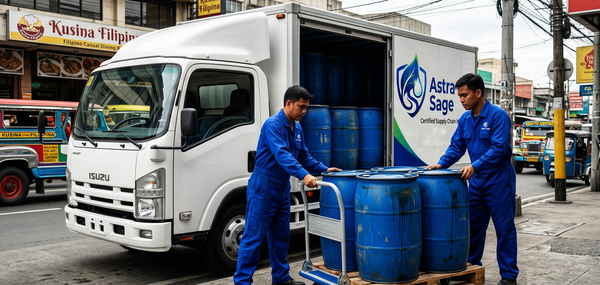
First, process controls replaced detection. Licensed waste-oil collectors, GPS-tracked waste-oil vehicles, municipal kitchen-waste source-separation mandates (Shanghai in 2019, Beijing in 2020, tier-1 cities thereafter). Shanghai alone now runs 18 designated collectors servicing 40,000 oil-producing units daily, generating roughly 40,000 tonnes of UCO a year.
Second, a legitimate buyer emerged. Beginning with a 2014 Boeing–COMAC demonstration producing sustainable aviation fuel (SAF) from waste oil, China's biofuel industry started absorbing what the black market used to take. By 2017, China was the world's largest UCO exporter. By 2023, 80% of its biodiesel output and 90% of its renewable-diesel output were going abroad.
Third, the price of legitimacy eventually beat the price of fraud. Shanghai now blends 600,000+ tonnes of B5 biodiesel annually through more than 300 gas stations — about half of Sinopec Shanghai's network. By end-2023, 36 million cars had burned 3 billion litres of B5 biodiesel. The waste oil that used to go back to dining tables now moves cars.
That is the real mechanism. Not executions. Legitimate demand priced above illegitimate demand.
Then came the pivot: waste into a national asset
For seven years — roughly 2017 to 2024 — China was content to export its waste oil. It sat on a 13% export tax rebate that made Chinese UCO irresistibly cheap for American and European refiners. In 2024, China exported a record 2.951 million metric tonnes of UCO, worth approximately USD 2.64 billion. The United States took 1.27 MMT (43%). The EU and Singapore each took about 737,000 tonnes.
Then Beijing changed its mind.
On 15 November 2024, the Ministry of Finance and the State Administration of Taxation announced that the 13% export tax rebate on UCO would end on 1 December 2024. The market moved within 72 hours: North China brown grease dropped 11% in three days. By the end of that December, UCO exports had fallen 60% month-on-month.
What triggered the shift? Four things converging:
- The EU slapped provisional anti-dumping duties of up to 36.4% on Chinese biodiesel in August 2024 — but explicitly exempted SAF, creating a regulatory arbitrage that made finished SAF far more attractive to export than raw feedstock.
- The US tightened its 45Z clean-fuel tax credit to favour domestic feedstocks; Trump-era tariffs then climbed to 125% on Chinese UCO by April 2025.
- Chinese biofuel producers had long argued the export rebate was subsidising their overseas competitors.
- And the 14th Five-Year Plan had already set a cumulative 50,000-tonne SAF consumption target, signalling that aviation decarbonisation — not feedstock export — was the strategic prize.
In September 2024, China launched a SAF pilot across four airports: Beijing Daxing, Chengdu Shuangliu, Zhengzhou Xinzheng, and Ningbo Lishe. By March 2025, all departing flights from those airports carried 1% SAF. Domestic SAF and biofuel refiners are now absorbing 100,000–120,000 tonnes of UCO per month — roughly 1.2 to 1.44 million tonnes a year, and rising. Industry analysts expect 1.07 billion gallons of new renewable-fuel capacity to be added in 2026 alone — about half of global additions for the year.
The arithmetic of what comes next is worth pausing on. If China enforces even a modest 2% SAF blending requirement, it would need roughly 3 million tonnes of UCO feedstock annually — more than its entire 2024 export volume. China would cease to be a net UCO exporter. A 5% mandate by 2030 would push it toward being a net UCO importer.
Why this is good for ordinary people
This is the part most policy write-ups undersell. The benefits aren't abstract.
- Restaurants stop being poisoning vectors. The economic pull of the biofuel industry means waste oil has more value going up the clean chain than down the dirty one.
- Food safety confidence is a consumer-surplus story. Every meal a family eats without worry is a benefit that doesn't appear on a balance sheet.
- Waste-oil collectors — once criminals — become licensed small businesses. A category of informal, often exploited labour gets formalised.
- Airlines decarbonise without a virgin-crop footprint. Unlike palm-oil-derived biofuel, UCO-based SAF doesn't compete with food crops or drive deforestation.
- Cities breathe cleaner air. Shanghai's 3 billion litres of B5 biodiesel displaced an equivalent volume of fossil diesel over roughly 15 years.
- A waste product becomes export revenue. USD 2.64 billion in 2024. That's not a rounding error; that's a mid-sized industry.
Why the Philippines should be paying close attention — right now
Here is the uncomfortable question for Manila: where is the Philippines' gutter oil going today?
The honest answer is: nobody at the national level really knows. A significant share of used cooking oil from restaurants, hotels, and food-processing plants in Metro Manila, Cebu, and Davao flows into informal channels — some reused in cheap eateries, some dumped into drains, some collected by small traders who sell it into opaque supply chains. There is no national registry, no GPS-tracked collection network, no provincial UCO accounting.
Meanwhile, the global market is screaming for this feedstock. Europe alone burns through roughly 130,000 barrels of UCO per day — about eight times what it can collect domestically. Global SAF targets by 2030 would require more than twice the UCO collectable from the US, EU, and China combined. And China, the world's largest supplier, is now pulling its supply off the export market.
This is not a hypothetical opportunity. It is a short, specific window.
Manila has over 40,000 food-service establishments and one of the highest restaurant densities in Southeast Asia. Cebu is both a tourist-restaurant hub and a shipping gateway — ideal for B24 marine-biofuel aggregation. Davao anchors a vast agri-food processing region where waste oil volumes from food manufacturing dwarf what's typically visible in urban estimates. Every one of these cities could be running a licensed-collector, kitchen-waste-separation, traceable-feedstock pipeline tomorrow. None of them is.
The policy bottleneck is speed, not ambition
Here is where the Philippine conversation has to get honest with itself. The country does not lack environmental laws. What it lacks is the institutional speed to turn a willing private investor into an operating plant before the window closes.
The Department of Environment and Natural Resources (DENR) and its Environmental Management Bureau (EMB) sit on the critical approvals: the Environmental Compliance Certificate (ECC), the Treatment, Storage and Disposal (TSD) permit, the Transporter's Permit Identification (TPID). Every month an ECC application sits in queue is a month of feedstock flowing into drains or the grey market. Every delayed TSD permit is a processing plant not built. Every TPID bottleneck is a collection route that never runs.
China's UCO-to-SAF pivot works in months, not years. When the export rebate was cancelled on 15 November 2024, domestic SAF absorption was already at industrial scale within one quarter. That is not because Chinese regulators are magic; it is because the permitting system was ready for the economics when they arrived. Philippine regulators do not have to copy Chinese governance. But they do have to match Chinese tempo on approvals — or watch the entire waste-to-biofuel opportunity go to Indonesia, Vietnam, and Malaysia, where governments are already moving.
The specific, unglamorous reforms needed:
Statutory decision clocks on ECC, TSD, and TPID applications for UCO-to-biofuel projects — with deemed-approval if the clock runs out.
A single-window UCO licensing regime combining DENR, EMB, DOE, and LGU permissions, so a collector-processor does not apply to five agencies in sequence.
Fiscal incentives structured to favour domestic processing over raw UCO export — China's 2024 rebate termination is the template, not the warning.
City-level kitchen-waste source-separation mandates in Manila, Cebu, and Davao first, with clear timelines for secondary cities.
Public-procurement pull: mandate a modest biofuel blend in government vehicle fleets and in Philippine Airlines' domestic routes. Shanghai proved demand creates collection; collection does not create demand.
The role of private capital — and why government cannot do this alone
This is not a public-sector project. It cannot be. The capex for a single SAF unit runs into hundreds of millions of dollars; for a nationwide UCO collection network, into the low billions. No Philippine government line agency has that in its budget, nor should it.
What the government can do — and must do — is make private capital bankable. That means:
Long-dated offtake certainty via a phased biofuel blending floor (even a modest 1% SAF target for domestic flights departing NAIA, Mactan–Cebu, and Davao would anchor investment).
Feedstock security via a licensed-collector regime that makes contracted UCO supply legally enforceable.
Clear sustainability standards aligned with EU RED III and ICAO CORSIA, so Philippine SAF can access premium export markets from day one.
Genuinely fast approvals. This bears repeating because it is the single biggest determinant of whether any of this actually happens.
Filipino entrepreneurs, diaspora capital, regional green-fund investors, and established Asian biofuel operators are all watching this space. The ones who move first capture the collection networks — and collection networks, once established, are hard to displace.
The future if nothing changes
The UCO problem does not get smaller by being ignored. Philippine foodservice is growing. Quick-service restaurant revenue, tourism-driven hotel volumes, food-manufacturing capacity in Mindanao and Central Luzon — all of them generate more waste oil every year. The volume of UCO produced in the Philippines will rise whether or not the country builds a system to handle it.
Without a system, three things happen in parallel. UCO continues flowing into informal reuse — meaning a slow, quiet Philippine version of China's pre-2011 problem persists. Environmental damage from drain-dumped oil accumulates in waterways and wastewater systems. And the export value that China, the EU, and regional peers are capturing flows past the Philippines entirely.
None of these failure modes is dramatic. That is precisely why they are dangerous. They do not generate the kind of crisis that forces action. They just quietly compound.
What a serious response looks like
The Philippines does not need to copy China. China's approach has real flaws — the 2024 Sinograin scandal showed that 13 years of enforcement did not fully close the loop at the state-enterprise level, and detection technology remains unsolved globally. Nobody has perfected this.
What the Philippines should take from China is narrower and more useful: the principle that waste oil only stops being a food-safety problem when it becomes an economic asset pointed at a legitimate, higher-value destination. Enforcement without economics is a treadmill. Economics without enforcement is fraud. Both are needed. And both rest on a permitting system that can move in quarters, not administrations.
Manila, Cebu, and Davao each have the ingredients. They have the waste volume, the private capital appetite, the export-market pull, and — if the political will arrives — the legal authority to issue the necessary permits. What they do not have is unlimited time. The global UCO market is being redrawn right now, in 2026, by decisions being made in Beijing, Brussels, and Washington. The Philippines can be a price-taker in someone else's market, or it can build its own.
The difference between those two outcomes is measured in months of permit processing at DENR and EMB.
Sources: USDA Foreign Agricultural Service (2024, 2025); S&P Global Commodity Insights; Reuters; Transport & Environment (2024); Carbon Direct (2025); IATA; Civil Aviation Administration of China; Li, Cui, Liu (2017), Global Health Promotion; Ma et al. (2021), PeerJ Computer Science; Sixth Tone, CNN Business, Washington Post coverage of the Sinograin 2024 scandal; PRC Ministry of Finance and State Administration of Taxation announcements (November 2024); 14th and 15th Five-Year Plans.