Local Governments Are Cracking Down on Used Cooking Oil — Is Your Business Ready?

If you own or operate a restaurant, carinderia, food stall, or any food business in the Philippines, take notice: local governments across the country are rapidly passing new ordinances that regulate, restrict, and penalize improper disposal of used cooking oil. What was once a matter of simply pouring old oil down the drain is now — legally — a punishable offense. The crackdown is accelerating, and businesses that aren't prepared face fines, permit revocations, and even criminal liability.
The National Problem: Hazardous Waste Is Growing Faster Than the Philippines Can Handle
Before we look at what local governments are doing, it's important to understand the national context that's driving this wave of regulation. According to data from the Philippine Statistics Authority, the country generated 269,552 tons of hazardous waste in 2024 — a 13% increase from the previous year. Among the types of hazardous waste, oil was the single largest category at 89,752 tons, representing a third of all hazardous garbage in the Philippines.
The problem? Hazardous waste is growing faster than the government can build disposal infrastructure. While the number of sanitary landfills increased to 343 in 2024 (up 14.7% year-on-year), this is nowhere near enough to serve all 1,634 local government units in the country. As the Philippine Daily Inquirer reported, this gap has made it urgent for the government to invest more in waste management infrastructure — and in the meantime, LGUs are stepping up with their own local enforcement measures.
⚠ The Bottom Line
Used cooking oil is legally classified as hazardous waste under DENR Administrative Order No. 2013-22. Improper disposal is not just an environmental issue — it's a criminal offense under Republic Act 6969. And local governments are now actively enforcing this.
City by City: The Regulatory Wave Sweeping the Philippines
Across the archipelago, local government units are no longer waiting for national enforcement alone. They are passing their own ordinances with specific mandates, penalties, and monitoring mechanisms for UCO disposal. Here is what's happening on the ground:
Quezon City
Ordinance No. SP-2691, S-2018 — The Used/Waste Cooking Oil and Grease Trap Waste Regulation Ordinance
Quezon City, the most populous city in Metro Manila, enacted Ordinance No. 2691 — formally titled "The Used/Waste Cooking Oil and Grease Trap Waste Regulation Ordinance." This landmark measure sets comprehensive policies for the transport, storage, reuse, recycling, reprocessing, and disposal of used cooking oil and grease by restaurants and similar food establishments across the city.
The ordinance strictly prohibits and penalizes non-segregation, illegal disposal and selling, and collection and transport by unauthorized entities of used cooking oil and grease trap waste. It mandates that all used cooking oil and grease trap waste shall only be transported, stored, reused, recycled, reprocessed, treated, and disposed by waste transporters or at Treatment, Storage, and Disposal (TSD) facilities accredited by the DENR and registered with the city's Environmental Protection and Waste Management Department (EPWMD, now known as the Department of Sanitation and Cleanup Works — DSQC).
All food establishments, TSD facilities, and their service providers are required to secure an Environmental Clearance from the EPWMD to ensure compliance with Republic Act No. 6969.
Penalties: ₱2,000 for the first offense, ₱3,000 for the second offense, and ₱5,000 for the third offense plus revocation of business permit. Vehicles, tools, and equipment used in illegal disposal and transport of waste cooking oil will be impounded.
The backdrop for this ordinance was stark: MMDA operatives discovered that many food establishments in Quezon City were disposing oil and grease directly into the sewage system without grease traps, causing massive drainage blockages and contributing to the city's persistent flooding — including the notorious grease-clogged drains of Tomas Morato Avenue.
Bacoor City, CaviteCity
Ordinance No. 447-2025 / No. 448-2025 — Used Cooking Oil and Grease Trap Waste Collection and Disposal Regulation Ordinance
In one of the most recent and comprehensive local actions, the City Government of Bacoor, led by Mayor Strike B. Revilla, enacted the Used Cooking Oil and Grease Trap Waste Collection and Disposal Regulation Ordinance in 2025. A formal implementation meeting was convened on March 24, 2026, bringing together key stakeholders including barangay chairmen, homeowners' association representatives, and private collection partners.
The ordinance covers all residential buildings and all commercial and institutional establishments in Bacoor — not just restaurants, but also households. Key provisions include:
Environmental Protection — Prohibiting the improper disposal of UCO into drainage systems and waterways to help reduce flood risks. Public Health — Addressing the illegal resale of unprocessed used oil that may pose health hazards to consumers. Mandatory Collection — All food establishments and residential households are mandated to turn over UCO and grease trap waste to accredited private collection entities. Households must comply every 30th of the month; food businesses every 15th and 30th.
The City Mayor is authorized to accredit private corporations for collection — and only those with prior experience in UCO-to-biodiesel conversion and who develop a smartphone app for real-time monitoring. Homeowners' association officers and barangay officials are deputized to help enforce the ordinance.
Cainta, Rizal
Municipal UCO Collection Initiative — October 2025
In October 2025, Cainta Mayor Kit Nieto launched a municipal initiative to purchase used cooking oil directly from households and food businesses. As reported by the Manila Bulletin, the LGU observed during repeated drainage declogging operations that hardened grease from kitchens was among the most common causes of blockages in the town's drainage system.
Under this initiative, the municipal government provides capital to fund organized groups that go around collecting and buying UCO from households and food stores. The collected oil is then sold to a company that filters it and exports it to Malaysia for biodiesel production. Mayor Nieto positioned this as part of Cainta's broader zero-waste campaign — alongside programs that recycle plastic bottles into park benches and convert banana peels into organic fertilizer.
Bacolod City
Proposed Ordinance — Regulation of UCO Transport, Storage, Recycling, and Disposal
The Bacolod City Council passed on second reading an ordinance regulating the transport, storage, reuse, recycling, reprocessing, or disposal of used cooking oil and grease waste by all food establishments. The measure was authored by Councilor Claudio Puentevella and requires all establishments generating UCO to register with the Bacolod Solid Waste Management Office for monitoring and compliance with RA 6969.
Penalties: ₱2,000 for the first offense, ₱3,000 for the second offense, ₱5,000 for the third offense plus revocation of business permit or imprisonment of up to five days.
Naga City
Camarines SurOrdinance No. 2026-010 — Used Oil and Grease Trap Waste Control Ordinance
Naga City enacted Ordinance No. 2026-010 in early 2026, one of the newest and most comprehensive local UCO regulations in the Philippines. It covers all establishments — not just food businesses but also automotive shops, commercial, and industrial entities.
All generators must register with the City Environment and Natural Resources Office (CENRO) within 60 days and declare their designated waste collector. Only CENRO-accredited collectors may collect and transport UCO. Prohibited acts explicitly include dumping, burning used oil, using used oil for cooking or food preparation, and unauthorized collection or disposal.
Penalties: ₱2,000 for the first offense, ₱4,000 for the second, and ₱5,000 plus revocation of business permit and/or imprisonment for the third offense. CENRO must formulate implementing rules and regulations within 15 days of the ordinance's approval.
Davao City
Executive Order No. 32, Series of 2015 — UCO Storage, Treatment, Transport, and Disposal
Davao City was a pioneer in this space, with an executive order issued back in 2015 that required all persons, households, vendors, and commercial establishments to comply with RA 6969 and DENR Administrative Order 2013-22 for the proper storage, treatment, transport, processing, and disposal of used cooking oil. The City Environment and Natural Resources Office (CENRO) was designated as the lead implementing agency. Davao also adopted UCO-to-biodiesel technology to fuel its municipal trucks and service vehicles.
The Trend Is Clear — And It's Accelerating
2015 Davao City
Executive Order No. 32 mandating proper UCO handling across the city — one of the first in the Philippines.
2018 Quezon City
Ordinance No. 2691 enacted — the most comprehensive UCO regulation in Metro Manila, with fines up to ₱5,000 and business permit revocation.
2023 Bacolod City
UCO regulation ordinance advanced to second reading, requiring all food establishments to register disposal activities.
2025 Bacoor City & Cainta, Rizal
Bacoor passes a comprehensive ordinance covering both residential and commercial generators. Cainta launches a municipal buyback program for UCO.
2026 Naga City
Ordinance No. 2026-010 enacted — one of the strictest, explicitly banning the use of used oil for cooking and requiring 60-day registration for all generators.
This is not a temporary trend. It's a nationwide shift. As more LGUs recognize the connection between improper UCO disposal and flooding, water contamination, and public health hazards, the regulatory wave will only expand. The question is not whether your city will pass a UCO ordinance — it's when.
What This Means for Your Restaurant or Food Business
If you operate a food establishment anywhere in the Philippines, here's what you need to understand:
📋 Your Legal Obligations (Now or Soon)
1. You cannot pour UCO down the drain. It's classified as hazardous waste under DENR DAO 2013-22 and RA 6969. Doing so exposes you to administrative fines (₱10,000–₱50,000 nationally) plus local penalties.
2. You cannot sell UCO to unauthorized collectors. Many LGUs now explicitly penalize both the seller and the unauthorized buyer. If your oil ends up being illegally resold for human consumption, you may share in the liability.
3. You must work with DENR-accredited entities. Whether it's transport, storage, or disposal — it must be done by a licensed waste transporter or accredited TSD facility. Local ordinances are adding their own registration requirements on top of national law.
4. You may need an Environmental Clearance. In cities like Quezon City, your food business must secure a clearance from the local environmental department as a condition of your business permit.
5. Non-compliance can cost you your business permit. Across multiple LGUs, the penalty for repeated violations is not just a fine — it's the revocation of your permit to operate
How Astra Sage Keeps You Compliant — Automatically
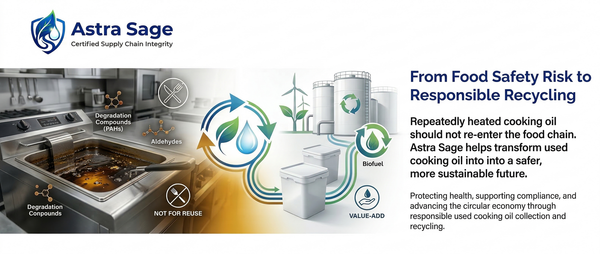
This is exactly why Astra Sage Incorporation exists. We don't just buy your used cooking oil — we make you compliant.
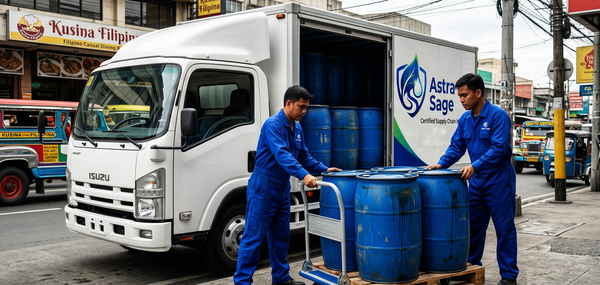
When you partner with Astra Sage, you get a fully licensed, authorized, and DENR-accredited UCO collection service. We handle the logistics, the documentation, the manifests, and the proper chain of custody for every liter we collect. Whether your city has already passed a UCO ordinance or is about to, your business is already covered.
Here's what you get:
Competitive market price for your UCO — This isn't a cost. It's a revenue stream. Every liter of UCO you sell to us offsets the cost of purchasing fresh cooking oil. Complete regulatory compliance — We provide all DENR-required documentation, proper manifests, and Environmental Clearance support so your business permit is never at risk. Reliable collection schedule — We work with your kitchen's rhythm, not against it. Regular pickups mean you never have UCO piling up. Guaranteed traceability — Your oil goes to industrial export markets for biodiesel, sustainable aviation fuel, and other legitimate applications. It will never re-enter the food chain. Peace of mind — Focus on your food, your customers, and your reputation. We take the waste problem off your hands.
✓ The Smart Move
Don't wait for your LGU to issue a citation or for an inspection to catch you off guard. Get ahead of the regulation curve now. Partner with Astra Sage and turn a compliance burden into a revenue stream — while protecting your business, your customers, and the environment.
Get Compliant. Get Paid. Get Started.
Contact Astra Sage Incorporation today for a free consultation. We'll assess your UCO output, set up a collection schedule, and ensure your business meets every national and local regulation — while paying you competitive market price for every liter.
Sources & References:
• Quezon City Ordinance SP-2691, S-2018 — quezoncity.gov.ph; Manila Bulletin, January 13, 2020 — mb.com.ph
• Bacoor City Ordinance No. 447-2025 / 448-2025 — City Government of Bacoor Official Facebook Page, March 24, 2026; bacoor.gov.ph
• Cainta, Rizal — Manila Bulletin, October 8, 2025 — mb.com.ph
• Philippines hazardous waste data — Philippine Daily Inquirer / Asian News Network, July 15, 2025 — inquirer.net
• Bacolod City — Visayan Daily Star, February 3, 2023; SunStar Bacolod, February 4, 2023
• Naga City Ordinance No. 2026-010 — naga.gov.ph
• Davao City Executive Order No. 32, Series of 2015 — SunStar Davao, January 4, 2016
• Republic Act 6969 — Official Gazette of the Republic of the Philippines